Stable voltage refers to the stable voltage value generated at both ends of a voltage regulator diode when it passes through the rated current. This value varies slightly with the working current and temperature. Due to different manufacturing processes, the voltage stabilization values of the same type of voltage regulator are not completely consistent. For example, the Vzmin and Vzmax of the 2CW51 voltage regulator are 3.0V and 3.6V respectively. Zener diode is a type of diode with voltage stabilizing function, which is made by utilizing the reverse breakdown state of the PN junction and the phenomenon that the current can change over a large range when the voltage is basically unchanged.
Zener diode is a semiconductor device with high resistance up to the critical reverse breakdown voltage. At this critical breakdown point, the reverse resistance drops to a very small value, the current increases, and the voltage remains unchanged in this low resistance region. Zener diodes are classified based on breakdown voltage, and due to this characteristic, they are mainly used as voltage regulators or voltage reference components. Zener diodes can be used in series at higher voltages, and higher stable voltages can be obtained through series connection.
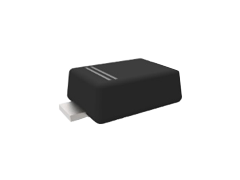
The forward characteristic of the voltage current characteristic curve of a voltage regulator diode is similar to that of a regular diode. The reverse characteristic is that when the reverse voltage is lower than the reverse breakdown voltage, the reverse resistance is high and the reverse leakage current is minimal. However, when the reverse voltage approaches the critical value of the reverse voltage, the reverse current suddenly increases, which is called breakdown. At this critical breakdown point, the reverse resistance suddenly drops to a very small value. Although the current varies over a large range, the voltage at both ends of the diode remains stable near the breakdown voltage, thus achieving the diode's voltage stabilization function.
The breakdown of voltage regulator diodes is mainly manifested as open circuit, short circuit, and unstable voltage regulator values. Among the three types of faults, the first one shows an increase in power supply voltage. The latter two types of faults manifest as the power supply voltage dropping to zero volts or unstable output. Overvoltage protection uses the breakdown voltage of a voltage regulator diode. Once the power supply voltage VCC exceeds the breakdown voltage of the voltage regulator diode, the Zener transistor will conduct. At this point, contact K will close, the relay will turn on, and the load RL will operate. When the VCC voltage is too low (not reaching the stable voltage value of the regulator), the contacts do not work and the relay will not close.